Guide to Improving Laws

Revision History
12/25/01 — incorporated some comments from John Forester, John Allen, Fred Oswald, Alan Wachtel, and Riley Geary.
1/01/02 — updated and improved links to state traffic codes in the Appendix. Deleted FL from list of states which can prohibit cyclists from making a standard left turn.
6/17/04 — removed PA from the mandatory sidepath list.
3/1/06 — removed AZ from list of states that seem to prohibit all sidewalk bicycling; removed VT from list of states with mandatory sidepath laws (repeal effective 7/1/04); added 2005 Colorado changes: right turn signal with right hand; repealed mandatory sidepath; single file not required if traffic unimpeded.
3/18/08 — added changes to VA laws from 2007: permits two abreast riding, standard language on exceptions to far-right rule, use of sidepaths cannot be required by local governments.

“Inferior legal status for cyclists turns cyclists into the lepers of the roads.”
John Forester, Effective Cycling. Sixth Edition. Cambridge, MA: The MIT Press, 1992. p. 250

This report is presented as a guide to improving the traffic law to provide fair and equal treatment for bicyclists. The analysis and recommendations should greatly assist those interested in preparing a comprehensive reform of the state vehicle code affecting bicycling in the states where they live. The report also is a resource for anyone interested in understanding how bicyclists are treated under the traffic laws.

I looked up bicycle-related provisions in the traffic laws of all 50 U.S. states to prepare this report. The official state websites have the traffic codes for each state, except for Georgia and Pennsylvania. The rules specifically mentioning bicycles for those two states are on unofficial websites. The web addresses for all 50 states are listed in the Appendix. A future version of this report will include the Canadian provinces. There are also thousands of local governments with traffic ordinances. As discussed below, the rules applying to bicycles in these codes may or may not be consistent with state law. The information presented in this report can also be used by those seeking to reform local laws affecting bicycling.

Why Traffic Law Matters

Although the highway codes of all states in the USA treat cyclists as drivers of vehicles, many unnecessary and prejudicial rules applying only to cyclists have been added in most but not all states. Such rules fuel the public perception that cyclists should not be classed as drivers of vehicles, providing false but legalistic arguments against treating cyclists as drivers of vehicles. The law should not reflect the belief that cyclists have inferior rights compared to motorists as users of the public roads. When traffic law if fair and reflects the principles of traffic engineering, judges, juries, attorneys, police, and the general public are much more likely to treat cyclists as drivers of vehicles.

There are several specific reasons that the traffic law pertaining to cycling should be free of prejudice. First, the statutes often form the basis of “safe bicycling” information given out by police and others. Second, the wording of the statutes affects law enforcement behavior. Third, the statutes are a factor in determining negligence in civil proceedings arising from crashes. Particularly because of the negligence question, the law should not require more equipment or more caution than is reasonably necessary for safe operation, since an opposing party may claim that failure to comply with statutes constitutes negligence.

The statutes should also be clear and require a minimum of cross-references to other portions of the code. It should be easy to correctly interpret the traffic law without referring to common law or rules of statutory construction or resorting to the concept that the traffic law cannot require one to do something unsafe.

Cyclists and the Traffic Law

There is no national traffic law in the United States. Each state has different laws concerning the operation of traffic. The National Committee on Uniform Traffic Laws and Ordinances (NCUTLO) is a private organization established in the 1920s to promote model traffic laws for states and local governments to adopt. The NCUTLO’s model law is the Uniform Vehicle Code (UVC), which is updated periodically. Every state has adopted a version of the UVC at some point, except that Massachusetts has never adopted a complete version of the code, and as a result lacks some rules that exist in almost every other state.

Persons Regulated by the Vehicle Codes

The vehicle codes regulate persons, not vehicles. The vehicle codes regulate two classes of person: pedestrians and drivers of vehicles. Pedestrians are those operating on foot, on sidewalks, crosswalks, and sometimes on roadways. Drivers are those operating any kind of wheeled vehicle, or riding horses or driving animals, on roadways, shoulders, or driveways. The term “vehicle” includes both non-motorized vehicles and motor vehicles. All drivers of vehicles must obey all the laws for drivers of vehicles. In addition, drivers of motor vehicles must obey additional rules for drivers of motor vehicles, rules requiring additional caution, certification, and insurance because of the great potential danger of motor vehicles when improperly operated. (There are some vehicles with very small motors whose operation is regulated as if they did not have motors.)

How the Rules Apply to Cyclists

Cyclists riding their bicycles on the roadway, shoulder, or driveway are considered drivers of vehicles and must operate according to the laws for drivers of vehicles. Cyclists walking with their bicycles are considered to be pedestrians, and must operate according to the laws for pedestrians. There are two problem areas. Cyclists walking with their bicycles for a short distance, as when on a hill that is too steep to climb, should still be regulated as drivers of vehicles. Cyclists riding their bicycles on pedestrian facilities should be regulated as pedestrians. The first is commonly glossed over as unimportant. As discussed below, the UVC and several states have explicitly adopted the second, which is important for safety.

In every state, cyclists are considered drivers of vehicles. That is, cyclists have the same duties and privileges as motorists with regard to the operation of vehicles in traffic. The general principles of traffic operation have been carefully thought out in a way to reduce collisions and to allow faster travel. Cyclists can function very well when they operate within this system, but typically fare much worse when they follow different rules.

In all states, motor vehicle operators, but not cyclists, must meet additional requirements such as driver licensing, vehicle registration, and liability insurance. The state traffic laws should be written in such a way as to clarify that these special rules apply only to motor vehicles and not to cyclists. For example, North Dakota’s statutes specify that points are not to be assessed against a cyclist’s license to operate a motor vehicles for infractions committed on a bicycle.

Almost all states define a cyclist as a driver of a vehicle by explicitly stating that cyclists have the rights and duties of drivers of vehicles. The one exception is Massachusetts, which says that cyclists have a right to use the public roads and must follow the traffic rules. (As of this writing, legislation is pending which would bring Massachusetts into conformity with the other 49 states in this respect.) Some states also include “bicycle” in the definition of “vehicle,” implying that the terms “drivers” or “operators” of vehicles include cyclists. Some states specify that bicycles are only considered vehicles for the purposes of the rules of operation of vehicles. New Jersey alone specifies that the term “driver” includes “bicyclist.” This definition is redundant but very helpful since most readers equate “driver” with “motorist.”

A common version of this basic rule is:

“Every person operating a bicycle upon a roadway has all the rights and is subject to all the duties applicable to the driver of any other vehicle as set out in this chapter, in addition to special regulations in this chapter, except as to those provisions of this chapter which by their nature have no application.” The wording “upon a roadway” is overly restrictive because the roadway does not include the shoulder. The rule should either say “upon a highway,” so it applies to both the roadway and the shoulder, or drop this clause altogether, as in the current UVC. Some states also specify that the traffic rules apply when bicycles are operated on paths. This is a useful clarification, but it is not strictly needed if the wording is simply “every person operating a bicycle” with no specification as to where.The exception for “provisions . . . which by their nature have no application” is unnecessarily vague. Those traffic laws not applying to cyclists should be written so that they specifically apply only to motor vehicles. Examples of these rules are those prohibiting driving or parking on sidewalks (see below).Most state statutes say that a parent or guardian may not knowingly permit a child or ward to violate these traffic rules. It is not clear to what degree this provision is enforceable. The rules for operating vehicles should also include the rules on reporting crashes, and these should apply to cyclists.
Recommended wording: A bicyclist has all of the rights and duties applicable to the driver of any other vehicle by the laws and regulations of this state governing the movement of vehicles.

Uniformity of Traffic Laws Within States

In general, state laws trump local laws. Some states have adopted a specific provision that traffic laws are uniform throughout the state and that no local government may enact provisions that are contrary to the state rules. Statewide uniformity is good for cyclists; without it local governments can and do enact provisions unfriendly to cyclists such as requiring sidewalk use or prohibiting cyclists from using certain roads.

Unfortunately, the UVC section on statewide uniformity has a section that specifically permits local governments to regulate “the operation of bicycles.” Regulating the “operation” of bicycles sounds like a license to enact local traffic rules that apply only to bicycles. Other than prohibiting bicycling on sidewalks where sidewalk bicycling is otherwise permitted by state law, no such local regulations are needed. The Colorado and Iowa statutes permit local regulation of bicycle operation, but add that such rules must be consistent with state law. This approach prevents local governments from enacting unwarranted bicycle-specific traffic rules. Without such a clause, it is possible for local governments to use the right to regulate the operation of bicycles as a basis for excluding bicycles from certain roadways. Massachusetts law takes another approach, explicitly stating that cyclists “have the right to use all ways.” Everywhere else this right is implicit in defining cyclists as drivers of vehicles, but in practice bicycle prohibitions are sometimes enacted. Cyclists may reasonably be excluded from express highways that do not provide direct access to any land uses and for which there is a reasonable alternative road.

State laws often allow for the registration and licensing of bicycles by local governments. However, local registration does not make much sense as a theft-prevention measure, since it is easy to ride bicycles across city boundaries. Mandatory registration rules have at times been used as a way to harass cyclists.

The UVC and five states (Delaware, Florida, Illinois, Rhode Island, and Utah) permit local governments to post signs prohibiting cyclists from making left turns in the normal vehicular manner. Some states, such as Vermont, specifically permit local governments to adopt helmet requirements.

Definition of “Bicycle”

Most states have a definition of the word “bicycle” in the traffic laws. The states that do not define “bicycle” are Kentucky, Massachusetts, Mississippi, Oklahoma, and South Dakota. The definition should be written so that it excludes scooters, mopeds, unicycles and children’s tricycles, but so that it does not exclude small-wheeled bicycles (such as found on some folding and recumbent bicycles) or adult tricycles.

Some states specify a minimum wheel size, others specify a minimum saddle height. Some exclude adult tricycles. These provisions are all overly restrictive. For example, North Dakota, West Virginia and Washington laws say that a bicycle must have at least one wheel greater than 20 inches. This wording excludes many folding and recumbent bicycles. The following 15 states require exactly two wheels, thereby excluding all tricycles: Alabama, Idaho, Illinois, Iowa, Kansas, Louisiana, Nebraska, New Jersey, New Mexico, North Dakota, Rhode Island, South Carolina, Texas, Utah, West Virginia.

Recommended wording: Bicycle: Every vehicle propelled solely by pedals, operated by one or more persons, and having two or more wheels, except children’s tricycles. The definition of children’s tricycles could be based on saddle to pedal distance.Bicycle-Specific Considerations in General Driving RulesAll the general rules for driving vehicles apply to bicycles. There are very few bicycle-specific rules that are necessary. There are only a few sections of the general traffic rules that need to be revised to take bicycles into account. In fact, several states (AR, IN, IA, KY, NC) have hardly any statutes that apply exclusively to bicycles.Right Turn Hand Signal

The standard hand signals for stopping and turning assume that the operator is seated on the left side of an enclosed vehicle and therefore can only use the left hand to signal. However, either hand of a cyclist or motorcyclist can be seen by other drivers. For the past 50 years, almost all motor vehicles have been equipped with automatic turn signals. Most people are not familiar with the standard hand signals, especially a right turn signal made with the left hand. Pointing right with the right arm is much more easily understood by all. Ironically, the only drivers who regularly use hand signals any more are cyclists. So far 23 states have changed their statutes to permit cyclists to make a right turn signal with the right hand. The most recent was Colorado (2005). Cyclists can make a stopping signal with either hand; the law should also permit it. A right-hand stopping signal is more effective and more visible when the cyclist is at the left side of a traffic lane, for example when riding on the left side of a one-way street.

Recommendation: Permit cyclists to signal a right turn with the right arm and a stop with either arm.

Continuous Signal

When automatic turn signals became common, a requirement to signal continuously in advance of the turn was added to the UVC. Most states have adopted some version of this requirement, specifying 100 to 300 feet as the continuous signal distance. A few still have older language that does not require a continuous signal. For example, Kentucky requires all drivers to signal “intermittently for the last fifty feet traveled by the vehicle before the turn.” While it is inconvenient for a motorist to make a continuous hand signal for 300 feet, it can be dangerous as well as inconvenient for a cyclist to do so, since both hands are needed for steering or braking. So far 24 states have either explicitly exempted cyclists from the continuous signal requirement or have never adopted the requirement.

Recommendation: If there is a requirement for continuous signaling, exempt cyclists from it.

Sidewalk Use

A person who walks a bike is considered a pedestrian in all jurisdictions. Although cyclists traveling at normal speeds are virtually always safer on the roadway than on the sidewalk, there are a few circumstances where sidewalk bicycling might be permitted. Outside of business districts, slow sidewalk cycling is reasonably safe and is convenient to let the cyclist go half a block on a one-way street. Pre-teen cyclists ought to be permitted (but not required) to use the sidewalk, at least in residential areas.

Some states have a rule that prohibits drivers from using sidewalks. This rule should exempt cyclists, at least in the specific situations described above. The following states include “bicycle” in the definition of “vehicle” and prohibit vehicle use of sidewalks: Indiana, Nevada, New Jersey, and North Dakota. Arguably, all sidewalk cycling is unlawful in those states.

At least 22 states explicitly permit bicycling on the sidewalks, usually with exceptions. In most of the other states, sidewalk bicycling is implicitly permitted since there is no general prohibition against driving vehicles on sidewalks. Sidewalk bicycling may be prohibited by signs or local ordinances. In Maryland and Wisconsin, sidewalk bicycling is not permitted unless a local government adopts an ordinance allowing it. Sidewalk bicycling is restricted to areas outside business districts in Alaska, Massachusetts, Maryland, Minnesota, Missouri, and Pennsylvania. Hawaii permits sidewalk bicycling only at speeds less than 10 mph. Of the 22 states that explicitly permit bicycling on sidewalks, 12 specify that sidewalk cyclists have the rights and duties of pedestrians.

Recommendation: Sidewalk cycling should be permitted, but not required, outside of business districts. Cyclists on the sidewalk should have the rights and duties of pedestrians but should also be required to yield to pedestrians on the sidewalk.

Manner of Making Left Turns

Cyclists and motorcyclists do not occupy the entire width of a travel lane. The rule for making a left turn should specify that the turn is to be made from the left-most portion of the road available for traffic in that direction, not merely the left-most lane available for traffic in that direction, unless left turn only lanes are designated.

Following Too Closely

The standard language in the Uniform Vehicle Code on following too closely (”tailgating”), if applied to bicycles, could be interpreted as prohibiting cyclists from riding in a pace line, where by common consent cyclists travel close enough to be sheltered from the wind. Not all states have adopted the tailgating rule. In many states the rule explicitly applies to “motor vehicles,” not “vehicles.” Regardless of the definition of vehicle, this rule should be rewritten to explicitly say that it applies to “drivers of motor vehicles.” Nine states have adopted a version of the statute that applies to all vehicles and includes bicycles in the definition of vehicle. These states are Delaware, Hawaii, Idaho, Missouri, Nevada, New Hampshire, Oregon, Texas, and Wyoming. It could be argued that drafting is unlawful in these states.

Parking on Sidewalks

Many states have adopted statewide parking rules that prohibit parking on sidewalks. In states where bicycles are considered vehicles, this prohibition applies to bicycles. Only a few states have specifically exempted bicycles from this requirement. Several states have statutes explicitly permitting parking bicycles on sidewalks, generally with the restriction that parked bicycles are not to block pedestrian flow. States should permit parking bicycles on sidewalks, with reasonable restrictions, as in the current version of the UVC.

Racing Rules

Some states have a rule prohibiting racing that is so broadly written that it could be construed to apply to any cyclists riding hard in a group. These rules should be modified so that they apply only to motor vehicles, not all vehicles. Special rules for bicycle racing should apply only to events in which the participants are allowed to violate the traffic laws. In this case, as in all similar cases of special use of highways, special permits are required.

Impeding Traffic

Some states have statutes prohibiting drivers from impeding traffic. These statutes should be written so that they apply only to motor vehicles, not to all vehicles. Otherwise, a broad version of this rule could be wrongly interpreted as prohibiting operation of bicycles or horse-drawn wagons whenever following drivers might be inconvenienced.

Slow-Moving Vehicle Rule

Most states have a rule requiring slow-moving vehicles to keep to the right. (Massachusetts again is an exception: that state requires all drivers to use the right lane except when passing or preparing a left turn.) The standard version (UVC) of this statute reads as follows:

“Upon all roadways any vehicle proceeding at less than the normal speed of traffic at the time and place and under the conditions then existing shall be driven in the right-hand lane then available for traffic, or as close as practicable to the right-hand curb or edge of the roadway, except when overtaking and passing another vehicle proceeding in the same direction or when preparing for a left turn at an intersection or into a private road, alley, or driveway.” In addition, 42 states have a rule specifically requiring cyclists to the keep to the right. As discussed below, the “bicycles keep to the far right” rule is redundant and prejudicial. The slow-moving vehicle rule is sufficient. However, two clarifications to the rule would be useful. First, the UVC was recently modified to clarify that the intent of the rule is convenience, not safety: “The intent of this subsection is to facilitate the overtaking of slowly moving vehicles by faster moving vehicles.” Although no state has yet adopted this addition, the Kentucky version of the rule (adopted in 1942) reads as follows (italics added): “The operator of any vehicle moving slowly upon a highway shall keep his vehicle as closely as practicable to the right-hand boundary of the highway, allowing more swiftly moving vehicles reasonably free passage to the left.” Second, the rules on lane use at intersections should supersede this rule. The wording used in Pennsylvania’s version expresses this concept: “This subsection does not apply to a driver who must necessarily drive in a lane other than the right-hand lane to continue on his intended route.” The slow-moving vehicle rule proposed here requires slower vehicles only to be in the right-hand lane on a multilane road, permitting cyclists to lawfully use all of a lane if there is a passing lane. Cyclists may then, for example, occupy an entire lane to ride double file, while the cyclists keep to far right rule would require riding on the right edge, even on a multilane road. Recommendation. Change the slow-moving vehicle rule to read: “Any vehicle proceeding at less than the normal speed of traffic at the time and place and under the conditions then existing shall be driven in the right-hand lane then available for traffic, or, if there is only one lane available for traffic in that direction, as close as is safe to the right-hand curb or edge of the roadway, except when overtaking and passing another vehicle proceeding in the same direction or when the driver of the slow-moving vehicle must necessarily drive in a lane other than the right-hand lane to continue on his or her intended route. The intent of this subsection is to facilitate the overtaking of slowly moving vehicles by faster moving vehicles.” Bicycle EquipmentNight Visibility From the FrontAll states require a head-lamp producing a white light on bicycles in use after dark. Forty-two require that the light be visible from a distance of 500 feet to the front. Six states require visibility from 300 feet (California, Georgia, Iowa, New Hampshire, North Carolina, and South Dakota). Maine requires visibility from only 200 feet. Kentucky requires that the light “reveal objects 50 feet ahead.” California specifies that the light must be visible from both the front and sides of the cyclist. Massachusetts and California explicitly permit lamps that produce light only while the bicycle is in motion (that is, generator lamps). Hawaii specifies that the lamp may be on the leg or arm of the cyclist.Recommendation: A head lamp producing a white light visible from 500 feet should be required. A generator light should be permitted by using the “while moving” qualification.

Night Visibility From the Rear

Only five states require a rear lamp emitting a red light: Alaska, Florida, New Jersey, New York, and Ohio. Of these five, Alaska, Florida, and Ohio also require a rear reflector. All the remaining states require a rear reflector, and specify that a rear lamp may be used in addition to, or in some states, instead of, the rear reflector. All specify that the reflector must be red, except South Dakota, which says, “red or yellow.” All but two states specify a minimum visibility distance for rear reflectors ranging from 600 to 200 feet (see Table 1). In many states the visibility requirement is less for reflectors (300 feet) than for the optional rear light (500 feet). Three states also specify a minimum reflector size (see also Table 1). Washington says that light emitting diodes (LEDs) may be used instead of the optional rear lamp. Wisconsin says that the optional rear light may be “red or flashing amber.”

Table 1. Rear Reflector Requirements

Visible under lower beams of motor vehicle headlights from: Count States
600 feet

18

AL, CO, CT, DE, FL, HI, LA, MD, MA, MI, MN, MO, NE, OH, OR, RI, WA, WY
500 feet

10

AK, CA, IL, IN, KY, MS, ND, PA, UT, WI
300 feet

17

AZ, GA, IO, KS, NV, NH, NJ, NM, NY, NC, OK, SC, TN, TX, VT, VA, WV
200 feet

2

ME, SD
“clearly visible”

1

ID
distance not specified

1

MT
Reflector at least: Count States
2 sq. in

2

MO, WI
4 sq. in

1

HI

Recommendation: A lamp emitting a red light visible from 600 (1000?) feet should be required. A red or yellow reflector visible from 600 feet should be permitted as a substitute, if it meets SAE A-71 or SAE A-84 (or is at least 2 square inches?) [either of these requirements would intentionally prevent the CPSC-standard rear reflector from meeting the rear visibility requirement without an added light or reflector].

Other Requirements Relating to Night Visibility

Nine states require pedal reflectors (California, Maine, Massachusetts, Minnesota, Missouri, Montana, New Hampshire, New York, and Rhode Island). Of these, Massachusetts, Missouri, and New Hampshire permit reflective ankle bands in lieu of reflectors on the pedals, a useful addition since many pedals cannot be equipped with reflectors. Rhode Island, on the other hand, requires pedal reflectors even on pedals sold separately from the bicycle.

Thirteen states require reflectors visible from the sides, usually placed on the wheels. These are Alaska, California, Colorado, Connecticut, Delaware, Louisiana, Massachusetts, Minnesota, Missouri, Montana, Nevada, New York, Ohio, and Rhode Island. Minnesota requires 20 square inches of reflective material, or side reflectors meeting CPSC regulations. Rhode Island requires 20 square inches of reflective material. Montana and Ohio say that reflective tires may be used to meet the side reflector requirement. Colorado, Delaware, and Nevada specify that a lamp may be used instead of reflective material visible from the side.

Maine requires reflector strips on the pedals and handlebars. Montana and Ohio require white front reflectors. Several state codes say that reflectors and lights in addition to those required are permitted.

Recommendation: Only front and rear visibility is necessary. Side reflection, although obvious to motorists in situations in which collision is very unlikely, is largely useless as a collision-prevention mechanism. By the time a moving bicycle is visible from the side under a motorist’s head-lamps, the two vehicles are no longer on a collision course. Supplementary reflectors should be permitted but not required. If side reflectors are required, they should not be limited to wheel reflectors, which can loosen spokes and can be hidden behind baggage, an aerodynamic fairing or the cyclist’s leg. If pedal reflectors are required, ankle bands should be specified as an acceptable alternative, in part because many pedals cannot accommodate pedal reflectors.

Brakes

There is a wide variety in bicycle braking provisions. As far as I have checked, every state has a rule specifying braking requirements. Some states say that the braking system should be sufficient to cause the rear wheel to skid, but others specify a specific stopping distance at a given speed. For example, Massachusetts requires a stopping distance of 30 feet or less at a speed of 15 mph. At least one state requires that the brakes should be sufficient to stop the bicycle in a “reasonable” distance.

Recommended wording: Every bicycle shall be equipped with a braking system to enable the operator to bring the bicycle traveling at a speed of fifteen miles per hour, or ten miles per hour if the bicycle has only a single pedal-operated rear-wheel brake, to a safe stop within fifteen feet on a dry, clean, hard, level surface.

Helmets

Currently 19 states have laws requiring helmets for children of some ages. California is the only state currently requiring helmets for everyone under 18. Oklahoma and Utah require helmets for children under 18 riding electric-assist bicycles, but have no helmet requirement at all for ordinary bicycles. Most of the 19 states with mandatory helmet laws have a cutoff at age 16 (see Table 2).

Table 2. Mandatory Helmet Laws by Cutoff Age

Helmets required for under age

Count

States

18

1

CA

16

11

AL, DE, FL, GA, HI, ME, MD, NC, OR, RI, TN

15

2

CT, WV

14

3

NJ, NY, VT (if required by local ordinance)

13

1

MA

12

1

LA, PA

Helmet laws should have “liability exclusion:” a statement that failure to use a helmet is not considered evidence of negligence. Using a helmet does not prevent a collision or fall. Most states have liability exclusions for seatbelts and child car seats and sometimes for adult motorcycle helmet requirements. Of the 19 states listed above, 12 have liability exclusions for bicycle helmet use, 4 do not, and for the remaining three I was unable to determine whether there is a liability exclusion.

Other Equipment

Some states require bells. Bells are unnecessary, since an audible signal can be made with the voice. The bell and other equipment requirements not discussed above are unnecessary and should be repealed. Having unnecessary requirements confuses enforcement efforts and can provide fodder for defense attorneys to claim negligence even if the requirement is irrelevant to the cause of a collision.

Discriminatory Rules

Only three elements are necessary in the traffic laws to account for bicycling: 1) the basic rule defining cyclists as drivers of vehicles; 2) a few minor modifications to the rules that apply to all drivers, and 3) bicycle-specific equipment rules. However, most states have also adopted discriminatory rules. These are rules of bicycle operation that do not apply to other vehicles. All of these are unnecessary. They can also be dangerous in that they encourage cyclists to operate in a way that deviates from the normal rules of the road and in that they encourage motorists, police, and courts to treat cyclists differently.

Bicycles to Far Right Rule

Forty-one states have adopted some form of a rule requiring cyclists to stay to the far right; nine have not (see Table 3). The far right rule is redundant since most states already have a slow-moving vehicle rule. It is also prejudicial because it applies to cyclists only. It is defective because it typically does not, read literally, permit cyclists to leave the right edge in many circumstances where it is unsafe or impractical to keep right.

Thirteen states have adopted the original far right rule that provides no exceptions and encourages cyclists to overtake on the right. That version reads as follows:

“Every person operating a bicycle upon a roadway shall ride as near to the right side of the roadway as practicable exercising due care when passing a standing vehicle or one proceeding in the same direction.” Ten states have adopted the current UVC version or something very close to it, which states: “(a) Any person operating a bicycle upon a roadway at less than the normal speed of traffic at the time and place and under the conditions then existing shall ride as close as practicable to the right-hand curb or edge of the roadway except under any of the following situations:

    1. i) When overtaking and passing another bicycle or vehicle proceeding in the same direction.
      ii) When preparing for a left turn at an intersection or into a private road or driveway.
      iii) When reasonably necessary to avoid conditions including, but not limited to, fixed or moving objects, parked or moving vehicles, bicycles, pedestrians, animals, surface hazards, or substandard width lanes that make it unsafe to continue along the right-hand curb or edge. For purposes of this section, a “substandard width lane” is a lane that is too narrow for a bicycle and a vehicle to travel safely side by side within the lane.

(b) Any person operating a bicycle or a moped upon a one-way highway with two or more marked traffic lanes may ride as near the left-hand curb or edge of such roadway as practicable.”The five exceptions to cyclists staying to the far right are thus: (1) when going as fast as other traffic; (2) when passing; (3) when preparing a left turn; (4) when avoiding hazards, including a narrow lane, and (5) when on a one-way street. California’s rule includes all these exceptions and adds, “when approaching a place where a right turn is authorized.” This is a necessary exception, since cyclists should not be in a right-turn only lane, or on the right edge of a dual-destination right or straight lane, if intending to go straight. Virginia’s law was amended in 2007 to include a similar exception: “When avoiding riding in a lane that must turn or diverge to the right.” (But does this cover the case of riding in the middle of a lane that serves both right turn and straight through movements?) Utah has an exception for cyclists avoiding a right-turn lane when going straight, but not for a cyclist staying to the center or left of a lane that permits both right and straight movements.Table 3. Exceptions to Far Right Rule by State

Exceptions to Far Right Rule count states
None

13

AL, AK, LA, MI, NM, ND, OH, OK, RI, SC, VT, WV, WY
Standard 5 exceptions

10

DE, FL, ID, IL, KS, MT, NE, OR, TX, WI
Standard 5 plus approaching right turn area

2

CA, VA
missing one-way streets exception

4

AZ, SD, TN, UT
missing speed exception

1

WA
missing speed and one-way street exceptions

2

CO, MN
missing one-way streets, “making left turn”

2

GA, NJ
missing speed exception, “making left turn”

2

MD, MO
missing speed exception, one-way streets, “making left turn” instead of “preparing left turn”

1

CT
missing exception for passing

1

HI
missing exception for passing and one-way streets

1

NV
missing exception for speed and passing

1

NY
missing exception for speed, passing and hazards, “making left turn”

1

ME
No Far Right Rule

9

AR, IN, IO, KY, MA, MS, NC, NH, PA
TOTAL

50

Many states with the rule have exceptions that do not match the standard ones. Several give an exception for “making” rather than “preparing” a left turn. In Missouri, cyclists must be both going faster than traffic and going the posted speed limit in order to be permitted to leave the right edge. Colorado requires cyclists to be in the right-hand lane, not the far right edge of the road, except when being overtaken. Maryland, Nevada, and Washington say that cyclists must ride as far as is “safe” rather than as is “practicable.” This is useful because “practicable” is frequently misinterpreted as “possible.” (In the chart above, I did not list those three states as lacking the exception for road hazards because they use the phrase “as far as safe.”)

Alaska’s version of the far right rule is particularly discriminatory. It states that cyclists “shall give way to the right as far as practicable to a motor vehicle proceeding in the same direction when the driver of the motor vehicle gives audible signal.” This version provides no exceptions. It is a clear example of bicycle inferiority written into law, since it says that cyclists must always give way to motor vehicles, but does not require cyclists to give way to faster cyclists.

Mandatory Bike Lane Use

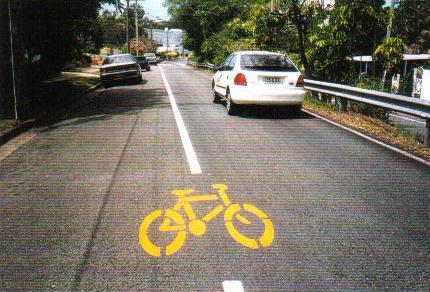
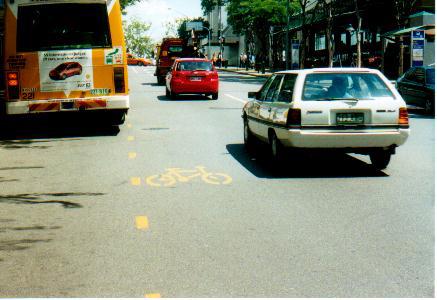
Six states require cyclists to use the bike lane if one is marked on the road (AL, CA, HI, MD, OR, PA). All of these rules, except Alabama’s, provide exceptions, as shown in Table 4.

Table 4. Exceptions to Mandatory Bike Lane Use Rule

State Exceptions
Alabama none
California not slower than other traffic, preparing a left turn, passing, avoiding road hazards, on a one-way street, or approaching a place where right-turns are permitted
Hawaii preparing a left turn; avoiding road hazards
Maryland preparing a left turn, passing, avoiding road hazards, or because the bike lane “is overlaid with a right turn lane, merge lane, or other marking that breaks the continuity of the bike lane”
New York lane not “usable,” preparing a left turn, or avoiding road hazards
Oregon use required only if certified “suitable for safe bicycle use at reasonable rates of speed” after a public hearing
Pennsylvania use required only if indicated by signs, unless not “possible, safe, or reasonable.”

Mandatory Shoulder Use

Four states require cyclists to use the shoulder, with the exceptions shown in Table 5. New York’s law ties together all of the above rules. Cyclists are required to use a bike lane, if none, then the shoulder, if none, then to keep to the far right “in such a manner as to prevent undue interference with the flow of traffic.”

Table 5. Exceptions to Mandatory Shoulder Use Rule

State

Exceptions

Alaska

shoulder not “in good condition”

Colorado

preparing a left turn, passing, or avoiding road hazards

Maryland

shoulder not “smooth,” preparing a left turn, passing, or avoiding road hazards, or shoulder “overlaid with a right turn lane, merge lane, or other marking that breaks the continuity of the bike lane” (same as bike lane exceptions)

New York

shoulder not “usable,” preparing a left turn, or avoiding road hazards (same as bike lane exceptions)

Mandatory Sidepath Use

Fifteen states still have some version of a mandatory sidepath rule, which typically reads: “Whenever a usable path for bicycles has been provided adjacent to a roadway, bicycle riders shall use such path and not the roadway.” Many states have repealed this rule in response to the objections of cyclists and the liability exposure which results from mandatory use of facilities known to be hazardous. The most recent repeals were Pennsylvania (1998), Vermont (2004), and Colorado (2005). The states that still have this rule are AL, GA, KS, LA, MI, NE, NY, ND, OK, OR, SC, UT, VA, WV, WY. In sic of these 15 states the rule applies only if there is a local ordinance or sign requiring path use (GA, MI, OK, OR, UT, VA). In Oregon, path use, like bike lane use, is not required unless the authorities determine after a public hearing that the path is “suitable for safe bicycle use at reasonable rates of speed.”

Number of Riders Abreast

There is no need to prohibit riding abreast since the rules on passing require cyclists to move right to permit overtaking and the slow-moving vehicle rule requires cyclists to keep to the right if going slower than other traffic. Eight states have no rule concerning the number of riders abreast. Fifteen other states prohibit bicycling more than two abreast, but permit riding two abreast. Twenty-one states permit riding two abreast unless traffic is impeded. Virginia’s rule permits two abreast riding when traffic is not impeded and adds that “Persons riding two abreast . . . shall move into a single file formation as quickly as is practicable when being overtaken from the rear by a faster moving vehicle.” (Prior to this change in 2007, Virginia was the only state that required single file riding without exceptions.) New York permits riding two abreast except when a cyclist is being overtaken. The remaining five states require cyclists to ride single file, with the exceptions shown in Table 6.

Table 6. Exceptions to Single File Requirement

State Exceptions

Colorado

when no traffic is impeded or on bike paths or lanes

Hawaii

when on bike lanes and where traffic is unimpeded

Massachusetts

when passing

Montana

when passing, on bike lanes, paved shoulder or parking lane, or on a multilane road when not impeding traffic

Nebraska

when on bike lanes or paths

Left Turn Prohibition

Five states and the UVC permit signs to be posted prohibiting cyclists from making a normal left turn (DE, IL, UT, RI, VA). A few states explicitly permit cyclists to make a pedestrian-style left turn but do not require it. Prohibiting only cyclists from making a vehicular-style left turn is discriminatory. Even on the most traveled roadways, there are times when it is easy for cyclists to merge left to turn. It is impossible to predict in advance and in absentia when it is desirable for a cyclist to make a pedestrian-style left turn instead of a vehicular-style left turn.

Expressway Prohibition

All states prohibit cyclists on at least some limited access divided express highways. Generally the prohibition is not by statute, but by decision of the Department of Transportation. In most western states and New Jersey, cyclists are permitted on Interstate-type highways outside urban areas unless there is a sign to the contrary. Some states require cyclists to get special permits for interstate use.

This rule should be entirely rewritten because it confuses lateral access with longitudinal access and presupposes that restriction of lateral access is the justification for prohibition of bicycles, which it is not.

Recommendation:

The rule on bicycle use of controlled access highways should be restated as follows: “Controlled access highway. The department shall not prohibit access to a highway from adjacent properties unless all property owners have transferred their right of access to the department. The department shall not prohibit bicycle from a roadway unless both the roadway is a controlled access highway and the department has determined that it is reasonable to prohibit bicycle use.”

Other Road Prohibitions

Maryland prohibits cyclists from using the roadway (but not the shoulder) if the posted speed limit exceeds 50 mph.

Special Requirements for Motorist Treatment of Cyclists

A few states have adopted special requirements governing how motorists are to act around cyclists. In general, these rules do not improve the situation compared to having motorists treat cyclists according to the rules for all drivers of vehicles.

Some states require motorists to pass cyclists at a safe speed and distance (in addition to the rule that all passing must be done at a safe distance). Many states also require motorists to use due care to avoid colliding with cyclists.

Maryland is the only state I know of with the following rules: “A person may not throw any object at or in the direction of any person riding a bicycle. A person may not open the door of any motor vehicle with intent to strike, injure, or interfere with any person riding a bicycle.” These seem to be reasonable requirements, although they are probably covered under statutes concerning assault.

Connecticut has a statute doubling the fine for drivers who fail to yield the right of way to a cyclist at an uncontrolled intersection, a T intersection, when turning left, or when entering the road.

Nevada law states that “the driver of a motor vehicle shall not intentionally interfere with the movement of a person lawfully riding a bicycle or overtake and pass a person riding a bicycle unless he can do so safely without endangering the person riding the bicycle.” It also states that “the operator of a bicycle shall not intentionally interfere with the movement of a motor vehicle or overtake and pass a motor vehicle unless he can do so safely without endangering himself or the occupants of the motor vehicle.”

Arizona and Wisconsin specify that motorists must leave at least three feet when passing cyclists. However in Wisconsin, cyclists must also leave at least three feet when passing motorists. This statute is not an improvement. If the overtaking vehicle is going very fast, three feet may not be a safe distance. On the other hand, if a cyclist is overtaking a stationary vehicle, much less than three feet may be perfectly safe. Arizona law further states that if a motorist passes with less than three feet and the result is serious injury or death of the cyclist, then the motorist will be subject to a civil penalty of up to $1,000. However, this civil penalty “does not apply to a cyclist who is injured in a vehicular traffic lane when a designated bicycle lane or path is present and passable.”

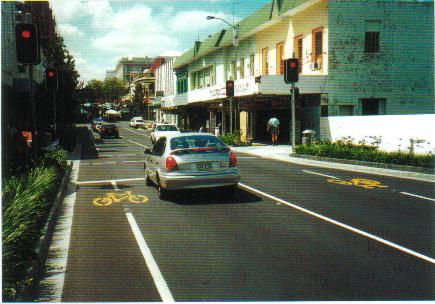
Finally, adding bike lanes to roadways can create confusion among motorists and cyclists. The standard rules on turning require the driver intending to turn right to approach the intersection from as close to the curb or edge of the roadway as practicable. Since the bike lane is part of the roadway, the motorist should merge into the bike lane in advance of turning. Minnesota has a statute that clarifies this:

“Whenever it is necessary for the driver of a motor vehicle to cross a bicycle lane adjacent to the driver’s lane of travel to make a turn, the driver shall drive the motor vehicle into the bicycle lane prior to making the turn, and shall make the turn, yielding the right-of-way to any vehicles approaching so close thereto as to constitute an immediate hazard.” It is not clear which vehicles the driver is yielding to according to the last clause.ConclusionsIn states which have adopted hardly any bicycle-specific laws, bicyclists are treated the same as any other vehicle operator. The only changes required in such states are the few bicycle-specific modifications to the general rules, such as in the manner of making turn signals. Other states have many statutes specifically applying to bicycles. Some of these are superfluous or discriminatory. At least some changes to remove discriminatory rules or clarify general traffic laws are needed in just about every state. Cyclists who wish to improve their state laws applying to bicycling can use the recommendations above to develop a detailed proposal for reform. The national cyclist organizations could also prepare a list of recommended changes to the Uniform Vehicle Code based on these suggestions.

5 Responses to “Guide to Improving Laws”

  1. John Allen on 15 May 2008 at 2:33 pm

    Text in tables runs off into black area.

  2. Dan Kennelly on 08 Jul 2008 at 9:05 pm

    Being a motorcyclist I read your comments about restrictive legislation with interest. It appears you advocate granting bicyclists all the rights of other, motorized vehicles without being willing to accept some of the responsibilities required of these other vehicles, specifically, no testing to demonstrate skills and knowledge of appropriate laws prior to operation, no requirement for renewable licenses, no vehicle license requirement. Why should bicycles, as vehicles, be permitted to use public highways for races, with or without permits when it would never be considered for other vehicles? I am not necessarily advocating banning bicycles from highways, but if you want all the privileges of use you should have to expect to pay.

    I think many of the problems perceived by bicyclists are shared by motorcyclists and the people representing both of these groups should be more aware of shared concerns and work together to impact the knowledge and actions of motorists to reduce the levels of death, injury and property damage currently seen.

    Thank you, Dan Kennelly, Central Ohio Norton Owners

  3. SiteAdmin on 08 Jul 2008 at 10:12 pm

    In response to Dan Kennelly:

    1. Bicyclists already have the same rights as drivers of motorized vehicles, as well as the same responsibilities. And yes, I advocate defending and strengthening this right.

    2. The issue of licensing frequently comes up, and I should post on it. Briefly, people are free to use the public roads; only inherently dangerous vehicles require a license. That’s historically why people walking, riding bikes, riding horses, and driving horse-drawn vehicles do not need licenses. You cannot take away the right to travel, only the privilege of operating a motorized vehicle. Moreover, any licensing scheme for bicyclists would criminalize bicycling by unlicensed children. And the vast majority of adult cyclists in the USA already possess a driver’s license.

    Even though a license is not required, bicyclists are required to obey the traffic laws and police officers are empowered to stop those who do not obey. I encourage anyone who thinks licensing of bicyclists is a good idea to instead encourage police and politicians to support even-handed enforcement of the law by officers trained in the rules of the road as they apply to bicycling. Such training is available at http://bicycledriving.org/enforce

    3. The use of roads for organized bicycle races typically requires a permit, although this varies by state and local law. I certainly believe that any race that involves suspension of the normal rules of the road should be required to obtain a permit.

    4. I completely agree with your last comment. I suggest contacting the Ohio Bicycle Federation. http://www.ohiobike.org/. I think they would be very happy to receive your suggestions. Nationally, the best contact is LAB, http://www.bikeleague.org.

  4. Betsy Gross on 13 Jul 2008 at 5:45 pm

    In reading “Guide to Improving Laws,” I noted the use of “IO” as an abbreviation for a state name in some of the tables. I live in Iowa. I checked the U.S. Postal Service’s website for a state with abbreviation “IO” and could not find one. The abbreviation for Iowa is “IA”. Can I assume “IO” refers to Iowa?

  5. DanC on 02 Aug 2008 at 12:06 am

    Paul, Are you aware of the “Vulnerable User” legal concept and Oregon’s new law? Since this concept is meant as safety improvement for non-motorized roadway users such as bicyclists, I think it merits inclusion. Here is an overview
    http://www.oregoncycling.org/2007/10/vulnerable-roadway-users/

Trackback this Post | Feed on comments to this Post

Leave your Comment